
Why the country's most ambitious organisations are finally asking HR to come to the strategy table — and what it takes to earn that seat.
For most of its corporate history, HR in Bangladesh was a back-office function. It processed payroll, maintained attendance registers, handled disciplinary paperwork, and occasionally organised a team event. Managers tolerated it. Employees feared it. Leadership largely ignored it.
That story is changing — slowly in some organisations, rapidly in others. Driven by fierce competition for talent, a maturing capital market, and the arrival of a more sophisticated workforce, Bangladeshi enterprises are discovering what global counterparts learned a generation ago: HR is either a strategic asset or a dead weight. There is no comfortable middle ground.
But what does “strategic HR” actually mean in the Bangladeshi context? And more practically, how do you build it from where most organizations currently stand?
“HR is either a strategic asset or a dead weight. There is no comfortable middle ground.”
Why the Old Model Is Breaking Down
The administrative HR model worked well enough when organisations were stable, talent was plentiful, and business strategy changed slowly. None of those conditions hold today.
Bangladesh's private sector — particularly banking, telecommunications, FMCG, and manufacturing — faces talent shortages at the mid-to-senior level that would have been unimaginable a decade ago. The country's best graduates now have genuine choices: multinationals, regional firms, entrepreneurial ventures, and increasingly, remote roles for global employers. An organisation that treats HR as a transactional function will simply lose this war quietly, one resignation at a time.
Meanwhile, boards and shareholders are asking harder questions about human capital. Succession risk, DEI gaps, compensation competitiveness, and culture health are now standard agenda items in serious governance conversations. The HR leader who cannot speak to these topics with data and strategic framing is rapidly becoming unemployable at the top of the market.
The Strategic Imperative
Organisations with strategic HR functions in South Asia report 2–3× lower voluntary attrition at the manager level, measurably shorter time-to-fill for critical roles, and significantly higher employee engagement scores — all of which translate directly into business performance.
The Five Foundations of Strategic HR
Building a strategic HR function is not a rebrand. It requires structural, capability, and cultural change across at least five dimensions.
1. Restructure the Function
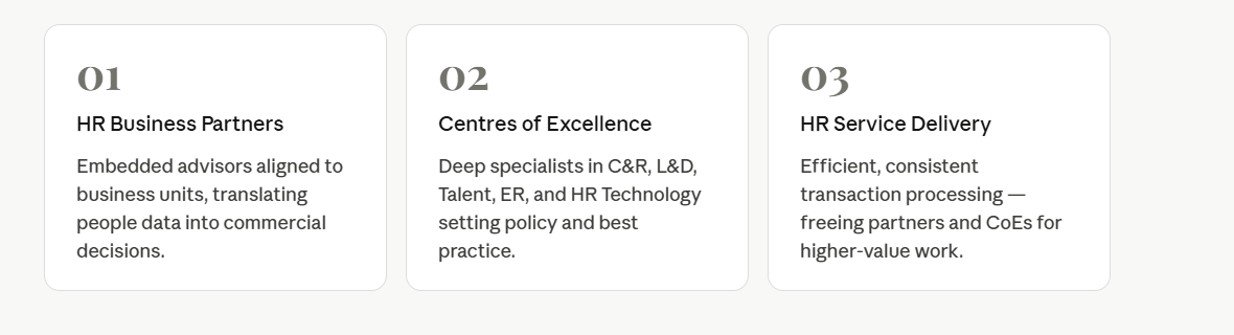
The most powerful structural shift is moving from a generalist model — where HR officers handle everything from hiring to counselling to compliance — to a Centre of Excellence (CoE) model. This separates specialist expertise (compensation, learning, talent acquisition, HR technology) from business partnering and service delivery. Each part of the function can then do its job with depth and discipline rather than being spread thin across everything.
In Bangladesh's large enterprises, this transition is already underway. Banks, telcos, and major conglomerates are investing in dedicated HR Business Partners who sit close to the business, and specialist CoEs that set frameworks and tools. The shift is not cosmetic — it requires new roles, new reporting lines, and frankly, new people in some seats.
2. Build a People Analytics Capability
Strategic HR requires data. Not headcount reports and attendance summaries — those are table stakes. True people analytics means understanding attrition predictors before people resign, identifying performance distribution patterns that reveal management quality, linking compensation positioning to offer acceptance rates, and modelling workforce scenarios for strategic planning.
Most Bangladeshi organizations are a long way from this. But the journey starts simply: agreeing on consistent data definitions, cleaning existing HRIS data, and building the habit of asking “what does the data say?” before making people decisions. HR leaders who invest in even basic analytical capability in the next two to three years will have a significant advantage over those who do not.
3. Redesign Performance Management
Performance management may be the most broken HR process in Bangladeshi corporate life. Annual appraisals conducted as a compliance ritual, ratings calibrated more by hierarchy than by output, and development conversations that never happen — this is the norm, not the exception.
Strategic HR demands a fundamentally different approach: performance frameworks anchored in clear business outcomes, regular check-ins that surface blockers early, calibration processes that ensure fairness across the organisation, and a genuine separation of development conversations from reward conversations. This is not easy to implement in cultures where hierarchy is strong and directness is uncomfortable. But it is achievable with the right design, the right training for managers, and visible commitment from the top.
“Performance management may be the most broken HR process in Bangladeshi corporate life. The path forward requires design, manager capability, and courageous leadership.”
4. Develop Real Talent Pipelines
Most organisations in Bangladesh react to vacancies. They post a job when someone leaves. Strategic HR organisations anticipate talent needs 12–18 months out, identify high-potential employees two levels below each critical role, and actively develop those individuals through stretch assignments, coaching, and deliberate exposure.
Succession planning in Bangladesh has often been a document exercise — a spreadsheet of names that satisfies a board requirement and gathers dust until someone suddenly resigns. Done properly, it is a live, calibrated process that dramatically reduces the business risk of sudden departures and builds employee commitment through visible investment in their futures.
5. Position the CHRO as a Business Leader
None of the above is possible if the most senior HR leader is positioned as an administrator. The Chief Human Resources Officer — or equivalent — must be a credible business partner to the CEO and the board. That means commercial literacy, data fluency, strategic courage, and the ability to give honest advice about people and culture even when it is uncomfortable.
In the best Bangladeshi enterprises today, the CHRO is part of ManCom not because of courtesy but because of contribution. They bring independent perspectives on organisational health, challenge assumptions about talent, and connect people strategy explicitly to business outcomes. This is the standard that ambitious HR leaders should hold themselves to — and that boards should demand.
Bangladesh-Specific Challenges
The Bangladeshi context presents a set of challenges that deserve honest acknowledgement, because generic strategic HR frameworks from Western textbooks do not always land cleanly here.
The regulatory environment — particularly the Bangladesh Labour Act 2006 and its amendments — creates compliance obligations that are genuinely time-consuming and require specialist legal knowledge. Strategic HR must absorb this reality, not pretend it doesn't exist. The answer is not to ignore compliance but to professionalise it through automation and specialist expertise, freeing generalist capacity for higher-value work.
The talent market remains shallow at certain skill levels, particularly in HR itself. Many organisations attempting to build strategic HR functions struggle to find HRBPs and CoE specialists with both technical depth and the business credibility to operate as true partners. Investing in developing this capability from within — through structured learning, secondments, and coaching — is often more reliable than hiring externally for fully-formed strategic HR professionals.
The cultural dimension of hierarchy and deference can make honest performance conversations, upward feedback, and leadership accountability genuinely difficult. HR can and should work with this grain rather than against it — designing processes that achieve honest outcomes through culturally resonant forms, rather than importing Western directness wholesale into environments where it creates discomfort without results.
A Note on Technology
HR technology investment in Bangladesh is accelerating. Cloud HRIS platforms, AI-assisted talent acquisition tools, and learning management systems are increasingly accessible even to mid-sized organisations. Strategic HR leaders should develop a clear technology roadmap — not chasing every shiny tool, but ensuring core data infrastructure is solid before building analytical and experience layers on top of it.
Where to Start
For HR leaders who want to move their functions in a more strategic direction, the temptation is to attempt everything at once. That usually results in nothing being done well. A more disciplined approach is to identify one or two areas where strategic HR can create visible, measurable business impact in the next twelve months — and deliver that value before expanding scope.
Often the highest-impact starting point is either performance management (if the current process is demoralizing and disconnected from business results) or talent pipeline work (if critical role vacancies are consistently a crisis). Fix the most painful problem first. Build credibility. Then expand.
The transformation from administrative HR to strategic HR in Bangladesh is not a destination that will be reached quickly. It is a journey that requires sustained investment, capable leadership, and organisational patience. But the organisations that make this investment — and make it seriously — will find themselves with a durable competitive advantage that is genuinely difficult to replicate: a people function that actually makes the business better.
That, ultimately, is what strategic HR is for.
Ready to transform your HR function from administration to architecture? Second Mountain Consulting helps organisations build strategic HR capabilities that deliver measurable business impact. Let's start the conversation.